How to Pass on Your First Attempt
Updated
Most people who fail the Life in the UK Test did not run out of ability; they ran out of preparation. Passing first time comes down to covering all ten chapters of the handbook material, testing yourself under the real 45-minute limit, and fixing weak topics before you book, not after.
Know the target: 18 correct out of 24
The test is 24 multiple-choice questions in 45 minutes, and the pass mark is 18 correct, or 75%. Each question is worth one mark, there is no negative marking, and the questions can come from any of the ten chapters of the official handbook. Published figures put first-attempt pass rates around 70 to 78 percent, which means a large minority pay the £50 twice.
Aim higher than 18 in practice. If your timed scores sit at 21 or 22, the three marks you lose to nerves on the day still leave you clear.
A study plan that covers every chapter
Give yourself four to six weeks if you are starting from nothing, and study in short daily sessions rather than long weekend ones. Facts like dates and names stick better when you meet them several times over several days.
Work through the chapters in order, because the history chapters build on each other, and finish each lesson with its quiz so you check recall straight away rather than at the end of the book.
- Weeks 1 and 2: read all ten chapters once, taking each lesson quiz as you go
- Week 3: reread the history chapters, which carry the most dates and names
- Week 4: timed mock tests every other day, revising the chapters that cost you marks in between
- Final week: two more timed mock tests, flashcards for anything still wrong, and rest the night before
Take timed mock tests and score above the line before you book
Reading tells you what the material is. Only a timed test tells you what you can recall with a clock running. Sit every mock test with the 45-minute limit on, no notes, and treat the result honestly.
Book the real test when three consecutive timed mocks come in at 21 or higher. If one of the three falls below 18, you have found a gap while it is still free to fix.
Where the app fits in the plan
The Life in the UK Test 2026 Pro app is built around this plan. It follows the official handbook in 10 chapters and 66 lessons, with 550 practice questions, 22 timed mock tests of 24 questions, flashcards built from your wrong answers, and a glossary of the terms the handbook uses. Everything works offline, so a commute counts as study time.
The first four chapters and the first two mock tests are free, which is enough to run the first fortnight of the plan and see whether the method works for you before paying for the rest.
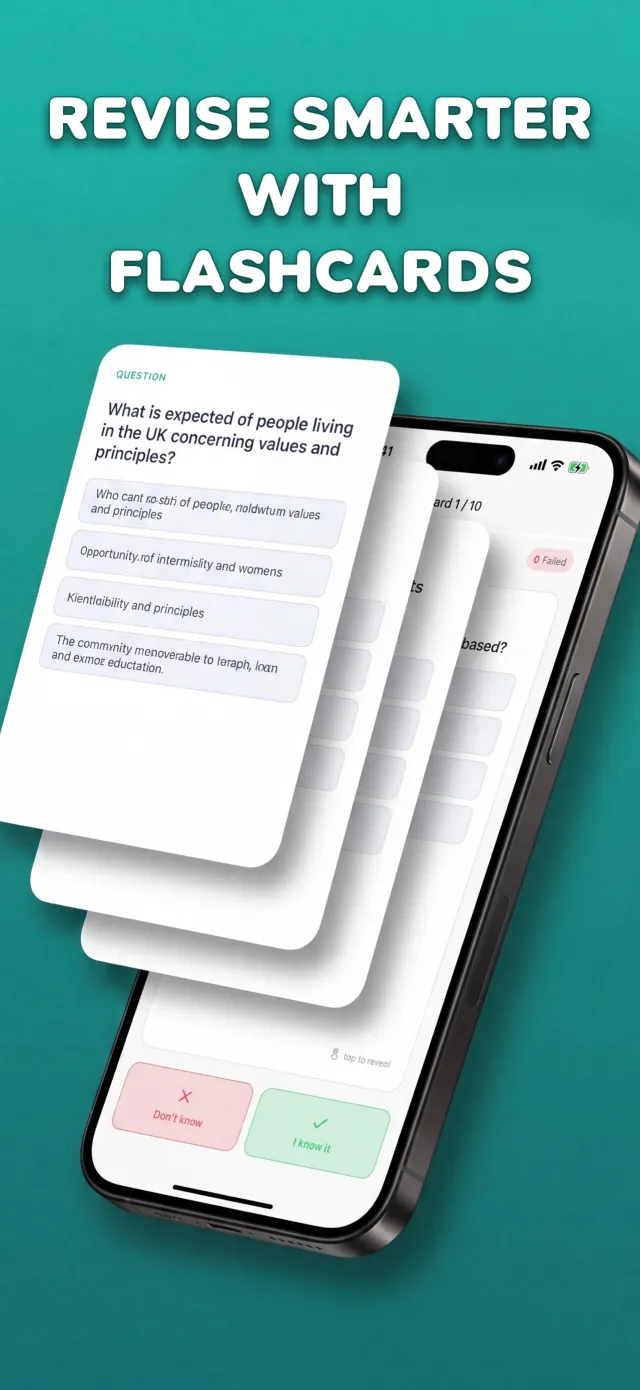
Turn every wrong answer into a flashcard
A wrong answer in a mock test is the most useful thing the test can give you, because it names a fact you do not yet know. Write it down, or let the app do it, and review it until you get it right twice without hesitating.
Swiping through a deck of your own mistakes for ten minutes a day fixes more marks than rereading a chapter you already half know.
The tips that make the biggest difference
Ask people who passed first time what they did differently and the same handful of habits comes up. None of them is clever; all of them are easy to skip.
- Read every option before you answer, even when the first one looks right
- On a select-two question, check you have selected exactly two
- Answer every question; a blank scores the same as a wrong answer
- Learn dates as a sequence of events rather than isolated numbers
- Do not neglect the short chapters; a question from a two-page section is worth the same mark
- Study the same content in two forms, reading and questions, rather than one form twice
- Stop studying the night before and sleep
Test-day routine
Arrive early with the identity document you used to book, because the details must match or you will not be allowed to sit. Phones and notes go away before you start. Then use the time: 45 minutes for 24 questions is nearly two minutes each, and most candidates finish with plenty to spare, so there is no reason to rush a single one.
You get your result at the centre. A pass covers both indefinite leave to remain and citizenship and never expires. If it goes wrong, nothing happens to your status; you wait at least seven days and rebook.
Frequently asked questions
How many mock tests before booking?
Book when three timed mock tests in a row score 21 or more out of 24. For most people that takes somewhere between five and ten mock tests, with revision in between, because early attempts expose gaps that need fixing before the scores settle. The number matters less than the consistency.
What to do in the last 24 hours before the test?
Run one final timed mock test in the morning, review your flashcards of wrong answers, then stop. Check the identity document you booked with, plan your route to the centre so you arrive early, and sleep properly. Cramming new material the night before tends to cost marks rather than gain them.
Related guides
Life in the UK Test: Pass Mark & Question Count 2026
24 questions, 45 minutes, 75% pass mark: how the scoring works, what a passing attempt looks like, and where the six spare marks usually go.
Read guideIs the Life in the UK Test Hard? (2026 Pass Rates)
First-attempt pass rates sit around 70 to 78 percent. What makes the test feel hard, which question types trip people up, and how to beat the average.
Read guideLife in the UK Test: Book vs App
The official handbook is the source of every question. What it does well, where it leaves you short, and how an app closes the gap to 18 out of 24.
Read guide